Record Times
©2006 Bill Ott
**Time keeps on slippin’...
slippin’... slippin’...
into the future**
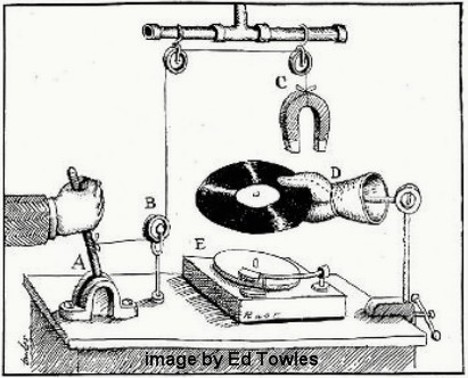
In the year 1895, a German immigrant... Emile Berliner was his name... submitted his latest invention to the U.S. Patent Office. Emile called it the ‘Gramophone’. It was quite an improvement over the ‘Phonograph’ Thomas Edison had patented back in 1877. Both could play (or in actuality - replay) pre-recorded voice or music. The Gramophone's major improvement was the use of flat metal disc ‘record’ instead of the impractical foil cylinder found on Edison’s Phonograph. Berliner’s theory of using a flat rotating disc for recording is still followed ala today’s CDs and DVDs.
One problem both Berliner and Edison’s players shared was maintaining a steady speed for the cylinder or disc to turn. Any variations - and the sound quality (such as it was) went to hell. Bear in mind electricity flowing into everyone’s home... as well as small precision electric motors... were still a few years down the road.
So, along comes Eldridge Johnson. He developed a clock-works type spring wound motor with a hand operated crank. After a few turns the motor would run at the same precise speed for a few minutes. Mr. Johnson even added a governor to this motor so with a few turns of a screw the speed could be changed and regulated. Sometime in 1901 Berliner and Johnson became partners and formed the Victor Talking Machine Co., which would eventually morph into RCA Victor.
But, that’s not what we’re here to talk about, is it? No sir.
We’re here to discuss early timing equipment, better known back in the 50's as ‘the clocks.’
Sometime back in the summer of 1952 (yikes!), The Topeka Drag-Ons Car Club had pretty near all their stuff together for running organized drag races. The guys from the club would provide track and safety personnel. Girlfriends would man the concession stand. The Topeka local officials gave them the go ahead to close the legendary ‘Nine-Tenths Mile Road’ to use as the track... provided the road would be cleared for normal traffic to resume, thirty minutes after the races ended! Hey, they don’t make City Councils like that any more, do they?
Anyway, let’s go back over all of this one more time. Track – check, Cars - check, chicks - check, eats and drinks – check, co-operation with the local authorities - check. Seems like that ought to about cover all the bases. Whoa... wait a minute!! What about timing equipment? Hand held stop watches just weren’t gonna cut it if this was to be a state of the art racing facility.
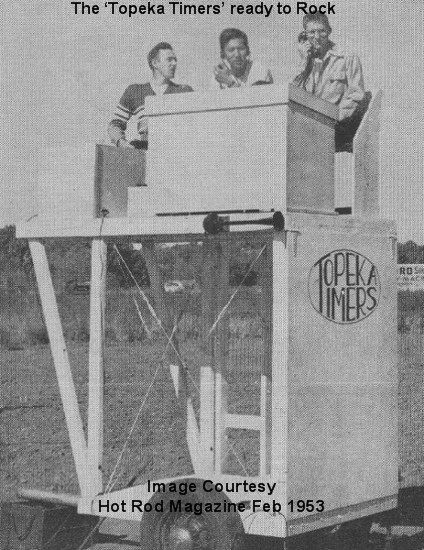
That’s when Bud Grandmontagne, Ted Fukuda, and Bruce Kirkpatrick stepped up to the plate and offered their services and collective genius. They had attended an earlier Drag-Ons meet and realized that more efficient and accurate timing equipment was in order and they had some ideas they wanted to try out. So here comes the cool part... the boys decided to build a portable timing tower complete with timer and communications equipment. Here’s how they did it.
Remember ol' Mr. Johnson and his spring wound phonograph turntable motor mentioned earlier? Well, one of those motors would be the heart of the whole system. Pneumatic air hoses like those used for traffic census or call bells in gas stations would be used to start and stop the timer. Batteries would be used for power in keeping with the portable theme. And a ‘party line’ type phone system (ask Grandmom or Grandpop what that means) would be utilized for communications.
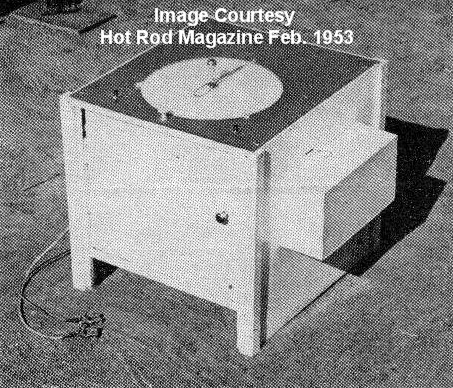
The turntable assembly was adjusted to turn at 60 RPM (one revolution per second) and a ‘start’ magnet assembly was attached to it. It was then mounted about three inches below the top board of the timing box. A flat steel plate with a ‘stop’ magnet assembly attached to it was mounted directly below the top board. From this plate a timing arm was mounted above the top board and could spin like the hand on a clock. When the start magnet was energized it pulled the top steel plate in contact with the already rotating shaft of the turntable motor. This assembly spun until the stop magnet energized, which made the assembly stop instantly... by way of the original ‘brake’ mounted to the turntable. Basically... what we’re talking here is a magnetically actuated, bigger than average, stop watch.
The times recorded by this assembly... up to a thousandth of a second they claimed... were converted to miles per hour... to the hundredth... via a chart. Bear in mind that at the first drags, elapsed times were never even considered... all anyone was concerned with was miles per hour.
The actuation of the timer was achieved by means of the two pneumatic air hoses. One was placed across the finish line, and the other was placed 176 feet before the finish. Don’t know how they arrived at the 176 foot figure. Hell... I’m not even sure if this was a quarter mile track! It might have been longer... or then again... it might have been shorter. Wally Parks and the High Sheriffs at the NHRA were asking all tracks to adhere to the same quarter mile course length... but things were still pretty much determined by the locals and facilities available.
Anyway... the two air hoses (I’m getting tired of spelling out pneumatic, so you can forget that word) had a box at one end that contained a diaphragm from a ‘49 Ford vacuum advance unit that would activate a breaker from an AutoLite voltage regulator. Incidentally... for the sake of accuracy the system was wired so that the breaker points were normally closed and opening them actually completed the circuit. Simple, no?
OK... that’s it for the complex stuff. Unless you count the automatic rewinding system the boys developed for that spring wound phonograph motor. Seems it was real easy to forget to keep that thing wound up during the races and this thing solved that problem. It utilized a Chrysler electric wiper motor assembly. But we won’t get into that.
The phone system included 2500 feet of phone line on a reel... made from 300' lengths of wire spliced together and four phones. There was a phone for the starting line crew to tell the guys in the tower who was making a pass. There were two phones in the timing tower. One to keep in touch with the starting line crew and one to pass along the times recorded to a track official (with his own phone) along the return road to relay to the drivers.
Now the reel all of this phone line was wrapped around had a bicycle chain and sprocket connected to an old Ford starter motor. Remember that proviso that the ‘track’ had to be reopened to traffic within a half hour after the races ended? Well, when things wound down all they had to do was mash a button and the phone wire was all reeled in... nice and neat... and quick.
And... here’s the best part. This whole timing tower assembly was mounted on wheels and could be hooked to the back of the family car and whisked away. Now HERE was one hell of a way to deal with disgruntled racers, track owners, cops, or... angry husbands.
This whole package cost Bud, Ted and Bruce right around $100.00 (American). They called themselves The Topeka Timers and I assume they hired themselves out to other races in the Kansas area. At the time the article I stole all of this stuff from was written... the speed record for their timer was a blistering 108.11 MPH.
And speaking of records... I wonder if the ‘The Topeka Timers’ ever tried hiring themselves out spinning platters at the local Sock Hops between races. Seems like with just a simple twist of a screw, that turntable could be re-set to turn 45, 78 or whatever RPM’s were hot back in 1952. And... if they brought along their chart... they could even tell you how fast the record went. To within 100th of a mile per hour!
More old B.S. later
BADCO
Forward advice, rebuttals, and death threats to badco@elp.rr.com
**©1976 ‘Fly Like An Eagle’
Words and Music By Steve Miller
**Sailor Records/Capitol Records**
From the Capitol Records Release ‘Fly Like An Eagle’
Released in May of 1976, the single ‘Fly Like An Eagle’ charted on Billboard’s Top 40 for fifteen weeks. The album charted on the Top 40 Albums for 48 weeks and reached Position 3. The album also included the #1 single ‘Rockin’ Me’.
A note of thanks to all of the usual suspects... you know who you are. And a fond farewell to Sally Ann LaPollo.
THANKS BUD